
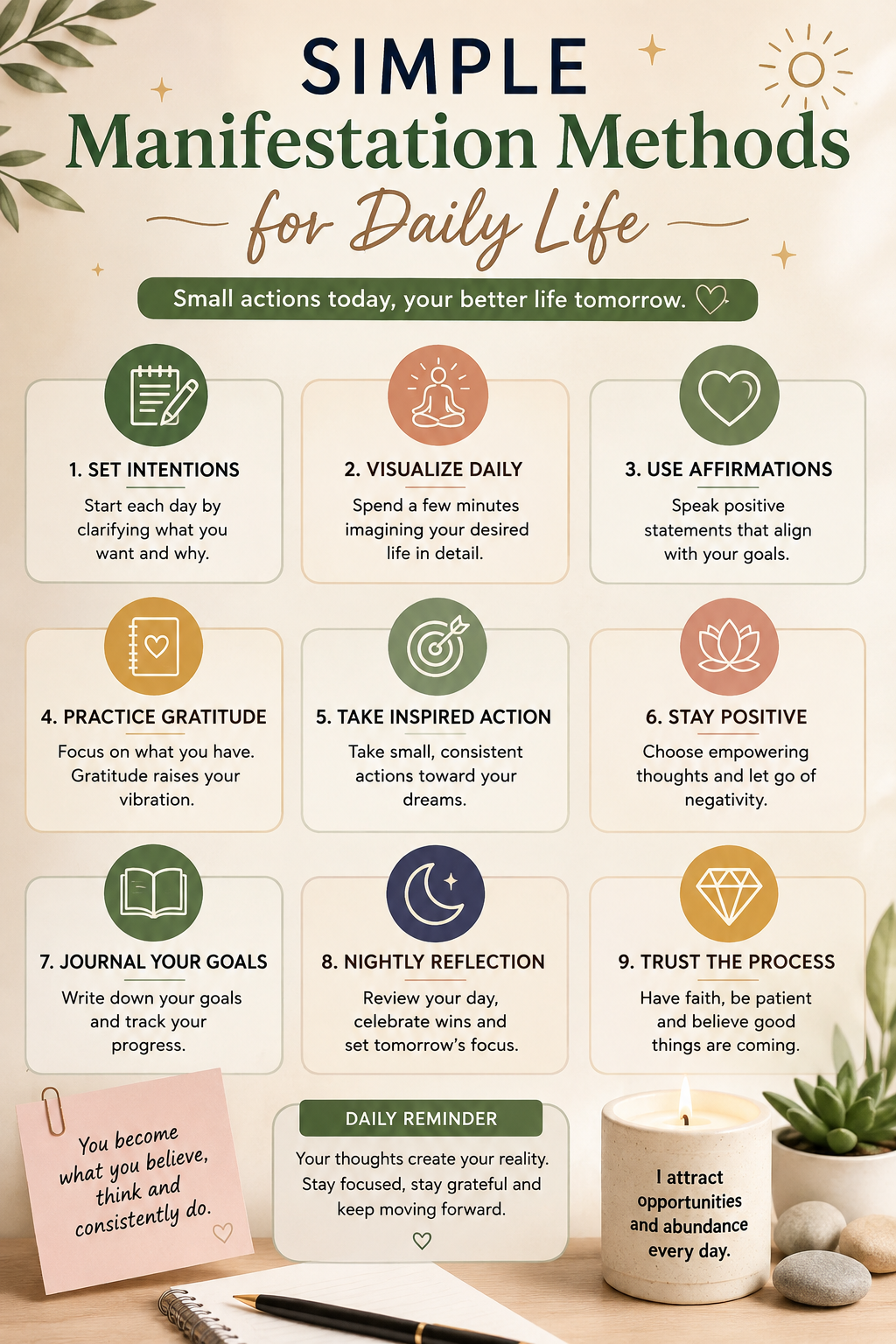
1. What are simple manifestation methods for daily life?
Simple manifestation methods for daily life are practical exercises that help you clarify what you want, focus your attention on your goals, develop supportive beliefs, and take consistent action. Popular methods include positive affirmations, visualization, gratitude journaling, goal setting, meditation, scripting, and creating daily intentions.
Rather than expecting thoughts alone to produce an outcome, it is more useful to combine manifestation practices with realistic actions. For example, if you want a new job, you might visualize yourself succeeding in your desired role, write affirmations about your abilities, and then apply for suitable positions every day.
This approach makes manifestation a daily mindset and goal-setting practice rather than a substitute for action.
2. How can I start manifesting as a beginner?
Start with one specific goal instead of trying to manifest several things simultaneously. Write down exactly what you want, why you want it, and one action you can take toward it today.
For example, instead of writing “I want more money,” you could write, “I want to increase my monthly income by developing an additional source of income.” Then identify a practical step, such as learning a skill, contacting potential clients, or creating an offer.
Spend five minutes each morning visualizing your desired outcome and five minutes deciding what action you will take. Consistency is more useful than performing complicated rituals.
3. Does manifestation actually work?
Manifestation is commonly described as using thoughts, beliefs, visualization, and intention to help create desired outcomes. However, there is not strong scientific evidence that simply thinking about something causes the external event to happen.
There is stronger psychological evidence for related practices such as goal setting, mental contrasting, and implementation intentions. Research has found that combining a desired outcome with awareness of obstacles and a specific action plan can support goal attainment.
Therefore, the most practical approach is to use manifestation as a tool for focus, motivation, reflection, and purposeful action.
4. What is the easiest manifestation method for beginners?
One of the easiest methods is the intention-and-action method. In the morning, write one thing you want to work toward and one action that supports it.
For example:
Intention: “I want to become more financially secure.”
Action: “Today I will spend 30 minutes developing a skill that could increase my income.”
You can then spend a few moments imagining yourself successfully completing the action. This method is simple because it connects your desired future with something you can actually do today.
5. How do I manifest something every day?
Create a short daily routine that combines intention, visualization, positive self-talk, gratitude, and action.
A simple routine could be:
- Write your main goal.
- Visualize the desired outcome for two to five minutes.
- Write three things you appreciate.
- Repeat one realistic affirmation.
- Choose one action that moves you closer to your goal.
- Review your progress at night.
The goal is not to spend hours thinking about your desires. A short routine that you consistently follow can be easier to maintain.
6. Can I manifest multiple things at once?
Yes, you can work on multiple goals, but beginners may find it easier to prioritize one or two important goals. Too many goals can divide your attention and make it difficult to determine which actions matter most.
Consider organizing your goals into categories such as career, finances, relationships, personal growth, and lifestyle. Choose one priority for the current month and give it most of your attention.
You can still keep a broader vision while focusing your daily actions on your highest-priority goal.
7. What should I write in a manifestation journal?
A manifestation journal can contain your goals, intentions, affirmations, gratitude statements, visualizations, obstacles, and daily actions.
For example:
My goal: Build a successful online business.
Why it matters: I want greater financial independence.
What success looks like: I consistently attract customers and generate sustainable income.
Obstacle: I sometimes procrastinate.
Action: I will complete one important marketing task before noon.
This type of journaling connects positive thinking with practical planning.
8. How does visualization help with manifestation?
Visualization involves mentally imagining a desired situation in detail. It can help you clarify what you want and mentally rehearse actions associated with a goal.
For example, if your goal is to become a confident public speaker, imagine yourself standing in front of an audience, speaking clearly, maintaining eye contact, and responding calmly to questions.
Research has also examined combining mental imagery with implementation intentions, suggesting that imagery can sometimes strengthen goal-directed plans.
Visualization should therefore be paired with preparation and action.
9. What are good manifestation affirmations for daily life?
Effective affirmations are usually specific, encouraging, and believable enough that you can engage with them consistently.
Examples include:
- “I take consistent steps toward my goals.”
- “I am capable of learning new skills.”
- “I notice opportunities and act on them.”
- “I am becoming more confident every day.”
- “I manage my time with greater intention.”
- “I am committed to building the life I want.”
Instead of repeating statements you strongly reject internally, adapt them so they encourage realistic progress.
10. Is gratitude a manifestation technique?
Gratitude is commonly included in manifestation routines because it encourages people to focus on what they appreciate rather than constantly concentrating on what they lack.
A simple practice is to write three things you appreciate each morning or evening. These could be major achievements or ordinary experiences such as supportive relationships, opportunities, health, learning, or a peaceful moment.
Gratitude does not guarantee that a particular external event will occur, but it can be a useful reflective practice within a broader personal-development routine.
11. What is the 3-6-9 manifestation method?
The 3-6-9 method is a popular manifestation practice in which a person writes a chosen affirmation three times in the morning, six times during the day, and nine times at night.
There is no established scientific evidence showing that the numbers three, six, and nine have a special ability to make manifestations happen.
If you enjoy the routine, you can use it as a journaling and attention-focusing exercise. The important part is to connect your written intention to practical behavior.
12. Can I use manifestation before going to sleep?
Yes. Bedtime can be a convenient time for reflection and visualization because it provides a quiet opportunity to review the day.
Before sleeping, write down what went well, identify one thing you want to improve tomorrow, and visualize yourself taking the next useful step toward your goal.
For example, if your goal is to exercise regularly, imagine yourself preparing your clothes, getting ready, and completing your planned workout the following morning.
13. What is scripting in manifestation?
Scripting involves writing about your desired future as though you are describing a meaningful experience or goal you want to achieve.
For example, you could write about what a successful workday would look like, what skills you have developed, how you manage your time, and how you feel about your progress.
For a more practical approach, finish the script by asking: “What can I do today to move toward this version of my life?”
That final question turns imagination into an actionable plan.
14. How often should I practice manifestation?
There is no scientifically established number of times you must practice manifestation. A short daily routine is often easier to maintain than an elaborate routine performed occasionally.
Try spending five to fifteen minutes per day on your practice. You could divide the time between journaling, visualization, affirmations, gratitude, and planning.
The most important factor is whether the practice helps you remain focused on meaningful goals and encourages constructive action.
15. What is a simple morning manifestation routine?
A beginner-friendly morning routine can take approximately ten minutes.
Minute 1–2: Write your main intention.
Minute 3–4: Visualize yourself making progress.
Minute 5: Repeat a positive affirmation.
Minute 6–7: Write three things you appreciate.
Minute 8–10: Choose one practical action for the day.
For example, if your intention is career growth, your action could be applying for one suitable position, contacting a professional connection, or spending time improving a relevant skill.
16. Can manifestation help me achieve goals?
Manifestation practices may help some people clarify goals, maintain attention, and stay motivated, but they should not be treated as a guarantee of success.
Goal achievement generally requires appropriate planning, effort, feedback, and adaptation. Research on implementation intentions has found that specific “if-then” plans can support goal-directed behavior.
For example:
If I feel like procrastinating, then I will work on my goal for just ten minutes before deciding whether to stop.
This makes a general intention more actionable.
17. What is an if-then manifestation technique?
An if-then technique converts an intention into a specific response.
For example:
“If I finish breakfast, then I will spend 20 minutes working on my business.”
“If I receive a negative response, then I will review my approach and try again.”
“If I feel discouraged, then I will remind myself of my goal and complete one small task.”
These plans are known in psychology as implementation intentions. Research has examined their relationship with goal attainment and self-regulation.
18. How can I manifest confidence?
Instead of waiting to feel confident before taking action, combine confidence-focused affirmations with small challenges.
You could write:
“I am becoming more confident through practice.”
Then choose an action that supports that belief. You might speak up during a meeting, make a phone call, publish your work, or learn something new.
Confidence often develops through repeated experiences of taking action, learning, and adjusting.
19. Can I use manifestation for financial goals?
You can use manifestation exercises to clarify financial goals and encourage yourself to notice opportunities, but manifestation should not replace financial planning.
For example, write a specific financial objective and identify the behaviors needed to support it. Depending on your circumstances, these could include budgeting, developing marketable skills, increasing sales, reducing unnecessary expenses, or exploring legitimate income opportunities.
A useful manifestation statement could be:
“I am becoming more intentional with money and taking practical steps toward greater financial stability.”
20. What are simple manifestation methods for busy people?
Busy people can use very short practices. Try a three-minute manifestation routine:
One minute: Identify your priority.
One minute: Visualize yourself completing it.
One minute: Decide the next action.
You can also use reminders on your phone, a notebook beside your bed, or a short affirmation on your workspace.
The purpose is to maintain awareness of your goals without allowing manifestation practices to become another overwhelming task.
21. Can I use manifestation for career success?
Yes, you can use manifestation as a career-planning and mindset practice. Start by describing the career outcome you want, then identify the skills, relationships, applications, projects, or habits that could move you toward it.
For example, someone seeking a promotion might visualize themselves confidently performing the responsibilities of the desired role while also improving their skills and documenting measurable achievements.
Mental contrasting—thinking about a desired outcome while also considering obstacles—has been studied as a goal-attainment strategy.
22. What manifestation method can I use when I feel stuck?
Try the wish-obstacle-plan method.
First, identify what you want. Second, identify the biggest obstacle currently preventing progress. Third, create an action for dealing with that obstacle.
For example:
Wish: “I want to publish more content.”
Obstacle: “I keep postponing writing.”
Plan: “If it is 9 a.m., then I will write for 30 minutes before checking social media.”
This approach is useful because it turns a vague desire into a specific response.
23. Is positive thinking enough for manifestation?
Positive thinking alone is unlikely to guarantee a desired outcome. A more useful approach is to combine optimism with realistic planning.
Research on mental contrasting suggests that simply imagining positive future outcomes is not always the most effective strategy; considering obstacles and creating plans can make goal pursuit more practical.
Therefore, instead of saying, “Everything will happen automatically,” consider saying:
“I believe this goal is possible, and I will take consistent steps toward it.”
24. What mistakes should beginners avoid when manifesting?
Common mistakes include expecting thoughts alone to change external circumstances, constantly changing goals, becoming obsessed with signs, avoiding practical action, and believing that failure means you had the “wrong energy.”
Another mistake is creating unrealistic expectations about how quickly results should appear.
A healthier approach is to use manifestation as a tool for intention, reflection, motivation, and goal planning. Track what you can control, learn from setbacks, and adjust your strategy when necessary.
For additional inspiration and practical personal-development content, you can also explore this guide to manifestation and personal growth practices.
25. What is the best simple manifestation method for daily life?
The best method is one that you can practice consistently while taking meaningful action. A simple combination is:
Set an intention → visualize the desired outcome → identify an obstacle → create an if-then plan → take action → review your progress.
For example, if your goal is to grow a business, visualize the type of business you want, identify what is currently holding you back, create a daily action plan, and complete one meaningful task each day.
Research on mental contrasting combined with implementation intentions found a small-to-medium positive effect on goal attainment across a large body of participants, although the researchers also noted limitations and possible publication bias.
Ultimately, manifestation is most useful when it helps turn an intention into consistent behavior. Your thoughts can help direct your attention, but your actions, decisions, learning, and persistence are what allow you to make measurable progress.
Helpful External Resources
For readers who want to explore the psychology behind goal achievement and related techniques, these research resources are useful:
- PubMed: Mental Contrasting With Implementation Intentions and Goal Attainment
- PubMed: Implementation Intentions and Goal Attainment
- PubMed: Implementation Intentions and Goal Progress
- PubMed: Mental Imagery and Implementation Intentions
These FAQs naturally target related searches such as simple manifestation methods, manifestation methods for beginners, daily manifestation routine, how to manifest daily, manifestation techniques that work, manifestation journaling, visualization manifestation techniques, manifestation affirmations, and how to manifest goals.